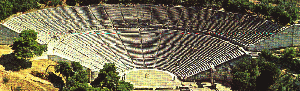
OPSIS THEATRE BUILDING AND SCENERY The theatre building as developed gradually during the 5th century BC, was structured in three main parts: the orchestra (dancing floor), the koilon (auditorium) and the skene (stage building). The orchestra, the oldest part in the evolution of the theatre building, was destined for the chorus which was present throughout the performance. It was the central area where dancing and singing took place. At that time, the orchestra, usually a circular place, was just of beaten earth, which facilitated the rhythmic movements of the chorus. At the centre of the orchestra stood thymeli, an altar for the offerings to Dionysus. The koilon, destined for the audience, occupied the largest part of the theatre building. Usually of semi-circular shape, it sloped on the hill-side, in an amphitheatric manner in front of the orchestra. During the earliest period, the spectators sat on roughly-made wooden stands but later, after the 5th century BC, the auditorium was wholly made of stone. A horizontal passage-way and a series of vertical staircases divided the auditorium into several sections. Originally the skene, where the actors performed, was just a simple wooden hut on the edge of the orchestra, functioning as a background for the action and also as a storage space. Gradually this structure acquired a more specific architectural style bringing to mind the front view of an ancient public building. Scenery (skenographia) in ancient Greek theatre had a simple and functional character. The spectacular and the stage realism were not of great importance. Therefore, the front view of the skene remained unchanged from one ploy to the other, while schematic movable painted panels were used to mark changes of landscape. Mechanic equipment serving the action was also simple and functional. The enkyklema, a roll-out platform coming through the main door, served as a means of bringing in front of the eyes of the spectators the outcome of a brutal act that had taken place somewhere outside their immediate field of vision. The crane enabled the actors playing the roles of gods and heroes to appear in the sky, thus giving the impression of flying.
MASKS
COSTUMES
ACTORS
|



